


Problems that may be encountered when using R-EPS-A350 application 1
Problems that may be encountered when using R-EPS-A350 application 1
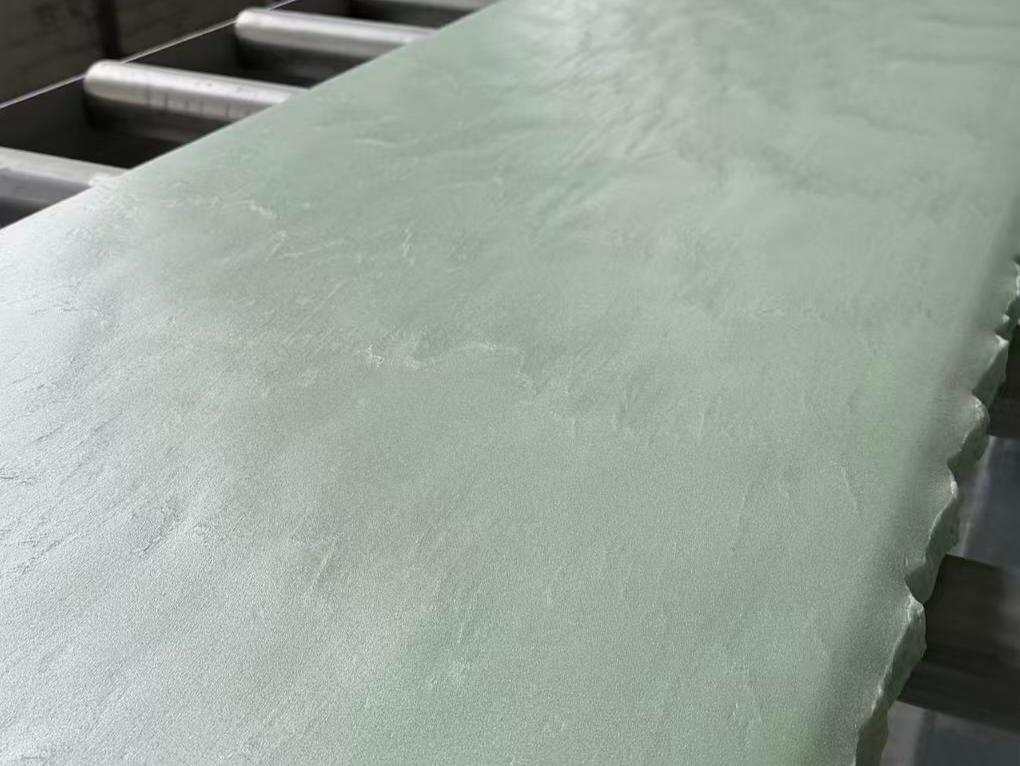
Wavy Surface of XPS Boards
A350 recycled polystyrene (R-PS) particles exhibit low ash content, high purity, and a high foaming ratio,
with performance parameters comparable to those of virgin expandable polystyrene (EPS) beads.
The XPS/EPS boards fabricated from these particles possess advantages including low bulk density,
excellent compressive strength, minimal deformation tendency, and low thermal conductivity.
However, the melt flow rate (MFR) of A350 R-PS ranges from 24 to 25.7, indicating a relatively low molecular weight.
Upon fluidization, the material exhibits a high flow rate and reduced viscosity,
which impairs its ability to retain the blowing agent,
thereby easily leading to the wavy surface morphology as illustrated in the figure.
To address this issue when utilizing A350 R-EPS, the following solutions are proposed:
- Reduce processing temperature: Gradually decrease the temp of Extruders 1 and 2 by 3–5 °C per batch to enhance the viscosity of the fluidized material.
- Decrease the blowing agent injection volume.
- Increase the dosage of nucleating agent (talc powder).
- Blend with low-MFR raw materials such as R-EPS-C150.